




GTIN Global Trade Item Number
The universal product identifier that powers global retail, e‑commerce, and supply chains -from a single can of soda to a pallet of goods.
What is a GTIN?
A GTIN (Global Trade Item Number) is a globally unique 8, 12, 13, or 14-digit number used to identify any trade item (product or service) that can be priced, ordered, or invoiced.
GTINs are the backbone of modern commerce - they ensure that a product is recognized the same way in a warehouse in Doha, a retailer in London, and an e-commerce platform in Singapore. Each distinct product variation (size, color, packaging) gets its own unique GTIN.
Purpose & usage
- Consumer units - individual products at point of sale (chocolate bar, shampoo bottle).
- Cases & cartons - multi-pack of consumer units for logistics.
- Logistics units - pallets (combined with SSCC).
- Digital assets - e-commerce listings, digital coupons.
- GTIN is mandatory for major retailers - (Carrefour, Lulu, Amazon, Monoprix) and e-marketplaces.
GTIN Structure
Depending on the variant, GTIN-12, GTIN-13, GTIN-14 or GTIN-8. Below is the most common: GTIN-13 (used in EAN-13 barcode).
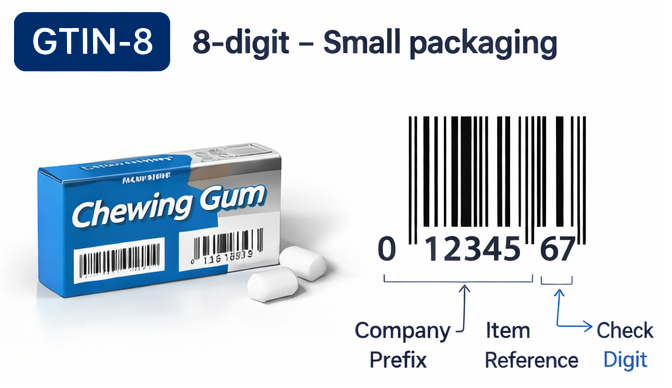
GTIN-8
GTIN-8 is used for small retail items where there is limited space for a GTIN-13. It provides a compact identifier while maintaining global product identification.
- 8 digit product identifier
- Used for very small packaging
- Assigned by GS1
- Common in cosmetics, small food items
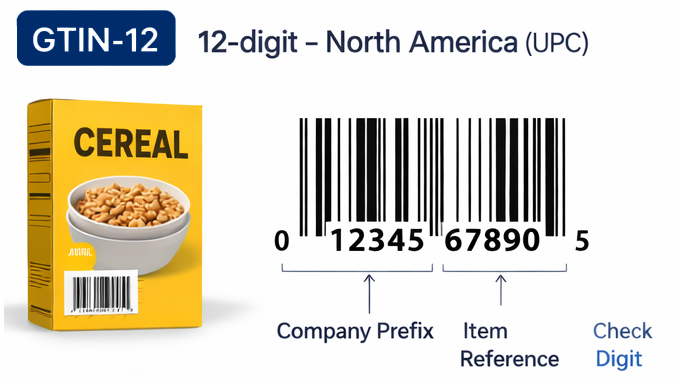
GTIN-12 Formats
GTIN-12 used primarily in North America. These formats still belong to the GTIN family and follow the same global identification principles.
- GTIN-12 (UPC)
- Used mainly in USA and Canada
- Retail barcode format
- Part of the GTIN numbering system
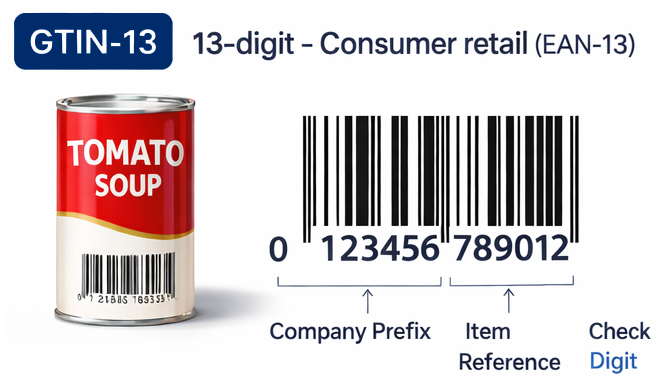
GTIN-13
GTIN-13 is the most commonly used product identifier worldwide. It is typically encoded in an EAN-13 barcode used in retail stores and supermarkets.
- 13 digit identifier
- Used for consumer retail products
- Scanned at point of sale
- Most common GTIN format
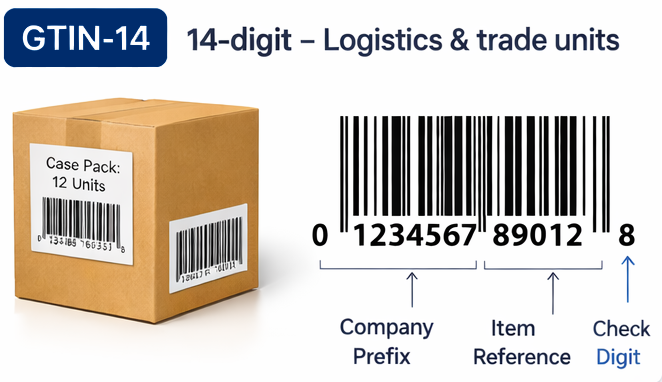
GTIN-14
GTIN-14 is used to identify trade items at higher packaging levels such as cartons, cases, or pallets in logistics and warehouse environments.
- 14 digit identifier
- Used for grouped products
- Common in logistics and distribution
- In the healthcare sector, GTIN-14 can be used for trading units that are scanned, such as products processed at a pharmacy cash register.
Key Benefits of Using GTIN
Global standardization that drives efficiency, trust, and growth.
Seamless Global Trade
One GTIN works across 150+ countries, eliminating translation or re-labeling for international sales.
Accurate Inventory & Sales Data
Track exact product movement, reduce out-of-stocks, and improve demand forecasting.
Enhanced Traceability
Recall readiness — identify affected batches instantly using GTIN + batch/lot numbers.
Omnichannel Readiness
Use the same GTIN for physical stores, marketplaces, and social commerce.
Consumer Trust & Safety
Authentic products verified via GTIN-based systems, reducing counterfeits.
Faster Checkout & Reduced Errors
Scanning eliminates manual price entry, improving speed and accuracy.
GTIN Best Practices
- Assign a new GTIN for each new product, size, color, or packaging change.
- Never reuse a GTIN for a different product (causes data chaos).
- Store GTINs in your master data system alongside product attributes.
- Validate check digits using GS1 official tool before printing barcodes.
Frequently Asked Questions
Additional Resources
Guides, videos, and tools to help you master GTIN.

How to obtain a GTIN in Qatar
GS1 Qatar is the only authorized issuer of GS1 prefixes (and therefore GTINs) in the country. The process is simple
- ✔ Apply for a GS1 Company Prefix - choose prefix size based on number of products.
- ✔ Assign GTINs - allocate unique numbers to each product variation.
- ✔ Generate barcodes - we provide software and guidelines.
- ✔ Go to market - your products are ready for global retail.
